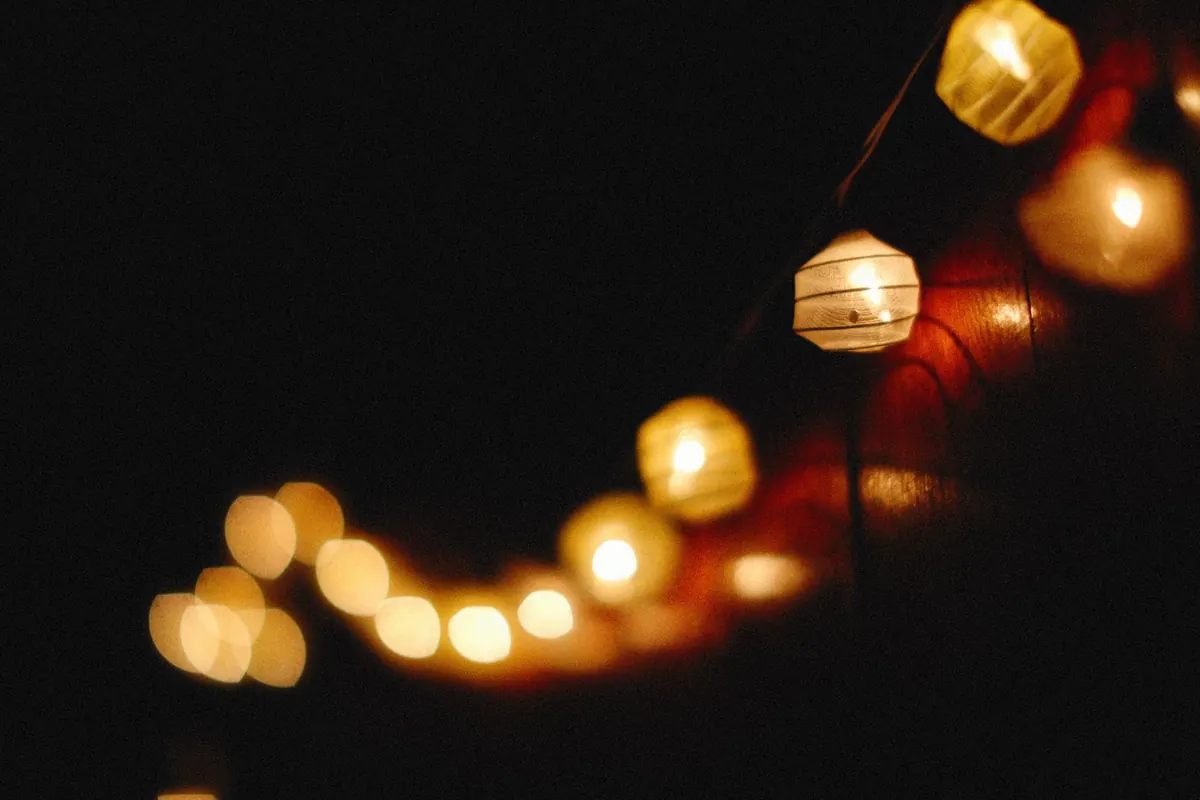
Autumn evenings arrive earlier than they should, and the ceiling light that felt fine in July suddenly reads like an office. The fix isn't more light. It's light placed at more than one height, so the room holds a few warm pools instead of one flat wash. Lanterns are unusually good at this: they shade the bulb, throw light sideways and down, and look right doing it. Layer three or four of them — floor, table, hanging — and the room becomes somewhere you want to sit until ten.
A single overhead fixture lights everything evenly, which is exactly the problem. Even light flattens a room: shadows disappear, corners look clinical, and you end up squinting at the glare while the sofa sits in the dark.
Layered light creates contrast instead — bright where you read, soft where you rest, dim at the edges. The eye reads those pools as depth, and depth is what makes a room feel bigger and warmer at the same time.
Three heights do most of the work:
Keep the color warm. Anything around 2200K to 2700K reads as candlelight rather than daylight, and if the whole group dims from one switch, the room becomes adjustable instead of fixed.
Start with the largest lantern you own, or the one you'd be happy to look at all winter, and put it on the floor. The corner behind a reading chair is the classic spot; the end of a sofa or the space beside a fireplace works almost as well.
Placement matters more than the lantern itself. Set it slightly behind and to the side of where you sit, so light falls across your page instead of into your eyes. If you can see the bare bulb when you look up, angle the lantern or add a diffusing shade.
Floor lanterns usually hold one bulb, so make it count. A warm LED in the 4 to 6 watt range — close to an old 40 watt incandescent — is often plenty in a corner. Put it on a dimmer plug or a switched outlet strip so you can drop it to a glow after dinner. Run the cord along the baseboard, and keep paper shades and dried arrangements well clear of any real flame.
This is where layering reads most clearly, because you can see two or three lanterns at once. Group them in odd numbers — three is easiest — and vary the heights by a clear step: a small 15 cm lantern, a mid 25 cm one, a taller 35 cm lantern in the same corner.
Balance matters as much as height. If one lantern is tall and narrow, let another be short and wide. Repeat a finish — brass, black metal, aged wood — across the group so the collection looks deliberate rather than accidental.
Use them where you already sit:
Battery lanterns with built-in timers are worth having on shelves and windowsills where cords are impractical. Mixing one real candle with two battery candles works better than it should; the eye catches the flicker and forgives the rest.
The upper third of a room is usually neglected, which is why ceilings seem to press down in November. One hook changes that.
Over a dining table, a pendant or lantern typically hangs with its lowest point about 30 to 36 inches above the tabletop — low enough to feel like part of the table, high enough to see across. In a living room, hang it off-center in a corner rather than the middle of the ceiling, and keep it clear of anywhere people walk; aim for head clearance above door height.
Renters can use a swag hook and chain, or a shepherd's hook in a corner. Where you can, anchor into a ceiling joist rather than drywall alone. For an open lantern hanging low, choose a frosted or vintage-style bulb so you see a soft glow instead of a filament staring back at you.
Do this once, at night, with every overhead light off.
That last step saves money. Most rooms don't need more lanterns; they need the ones already there moved a foot to the left.
Consistency is what separates a designed room from a room that simply has a lot of lamps. Keep every bulb in the same warm range and avoid leaving a cool white one in a lantern "for now" — a single 4000K bulb in a row of warm ones is visible from across the room.
Other small choices that pay off:
Light the room in the order you'd light a fire. Floor lantern first, then the tabletop group, then the hanging lantern last and dimmest. Blow out real candles before bed and set the timers so one low lantern stays on for anyone making a late trip to the kitchen.
That's the whole method: three heights, one warm color, and a dimmer. Do it tonight and the season gets a little longer.
Photo: Alexey Demidov / Pexels

A practical checklist for lakeside lantern releases: permits, biodegradable materials, written wind limits, launch...
Lumens, kelvins and CRI decide how bright a lantern feels, what color its light casts, and whether you can tell red...

Rust on an old lantern is usually surface damage, not a death sentence. Here's how to clean, polish and reseal one...

Bright ideas and beautiful lanterns for every space..
